सर्वधर्मान् परित्यज्य मामेकं शरणं व्रज । अहं त्वा सर्वपापेभ्यो मोक्षयिष्यामि मा शुचः ।।18.66।। Take refuge under me leaving all other dharmas. I will get you relieved from all problems. Do not worry”

Vishnvarchana
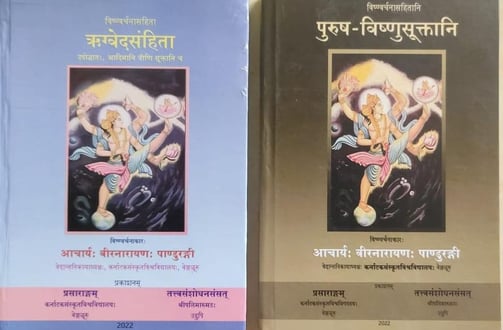
Vishnvarchana is the only one and most detailed Samskrit commentary on Rgveda ever written. Vishnvarchana, depicting Vishnu as the primary meaning of all Vedas, as the name itself indicates, is being written in the context of Vedic and allied texts treading the path shown by Madhvacharya that how each mantra has got at least three meanings, while using and examining modern scholarship on Rgveda.
First two volumes written by Acharya Veeranarayana Pandurangi were published in 2022.
Third volume of this commentary is now being written by a team supported by Poornaprajna Samshodhana Trust and lead by Acharya Veeranarayana Pandurangi. Third volume on 4-20 Suktas of First Mandala of Rgveda is expected in 2025.
English version of this commentary is also expected in 2025.
It is proposed to write new commentaries on Yajurveda Samaveda and Atharvaveda using the same methodology.

Support Vishnvarchana
Donate liberally to support Vishnvarchana


Printing Vishnvarchana each volume Rs. 1,50,000
Preparation of each volume Rs 4,00,000
Contact for copies
First two volumes of this commentary of Rgvedasamhita are published jointly by Tattvasamshodhana Samsat, Udupi, and Karnataka Samskrit University, Bengaluru. Both are priced at Rs 500 each. These can be had from Dr. Vamshikrishna Purhohi, Director, TSS Udupi +91 81234 58634.
Also available online https://madhwakart.com/product/rugveda-samhita/
https://madhwakart.com/product/purusha-vishnusuktani/
Introductory pages and ToC are uploaded here.
https://www.academia.edu/97551263/English_preface_to_Vishnvarchana_commentary_of_Rgveda_Vol_1
https://www.academia.edu/97553195/Vishnvarchana_vol_1_preliminary_pages
https://www.academia.edu/100024869/Review_of_Vishnvarchana_vol_1_by_Prof_Pratosh
https://www.academia.edu/97438097/Purusha_vishnusuktani_preliminary_pages
Videos of seminars held on the occasion of release are available here by searching Vishnvarchana grantha lokarpana 1-14 on youtube.
SB AC 74670100007586
IFSC-- BARBOVJKATH Krishna Bhakti Peetha, Bank of Baroda, Katriguppa Branch, Bengaluru
Detailed account of Vishnvarchana commentary on Rgveda
Vedas are the base of Indian culture. India stands firmly on the Vedas. India is the only country in the world to have continuous civilization for atleast 7000 years. Bauddhas, Jainas, Charvakas, Shakas, Hoonas and Mohammadans have tried their hand to destroy the Vedic civilization by discrediting Vedas from the very beginning. These systems fought intellectual and physical wars on Indian philosophies and State. They were fiercely countered by both scholars and warriors. It is famously said that “the Ship of Islam sunk in the River Ganga” both physically and philosophically. These systems did not succeed because they failed in creating a general disregard for Vedas in Indian masses. However, Christians have succeeded where Bauddhas, Jainas and Mohammadans had miserably failed. It is more easy to destroy a system from inside than from outside. Christians entered inside Vedas and woven a net of misinterpretation and mispropogation in the guise of interpreting them. Most of the Samskrit scholars of India were not aware/capable of rebutting such theories, not to mention the laymen. This is where we Indian scholars have failed. Our Scholars could have kicked Indologists out had they put at least ten percent of their energy in the refutation of these Western Scholars. But they did not venture into it. Instead, they welcomed Indologists’ efforts in Vedic interpretations. Western Indologists posed themselves as new Brahmanas. Max Mueller was rechristened as Moksha Mullara Bhatta (Satawalekar 1940). He was considered as a Pandit. I have no doubt about of his scholarship of whatever extent. But I have hesitation to call him Pandita Moksha Mullara Bhatta. Everyone is aware of his real intentions. Such was the moha of Indian scholars at that time.
But the result of Western Indologists’ effort was devastative. All the English-educated neo-enlightened(?) accepted what these people wrote, because they no longer got entrance in Samskrit Language. We Indian scholars were not able to counter our western counterparts either because we did not work out in English or our countrymen fell in the traps of colonial power. We did not try to correct this situation even after the independence. Nobody knows what to do to reverse the trend. It is for, at least, this reason I had to venture to write my commentary. I am not worried about what Western counterparts think or write about my new comprehensive commentary. I expect my countrymen should try their hands in writing reviews of western interpretation. We have both Right and Might to do it.
Initially my interest was in understanding what Western Indologists have written on Rgveda and review their writings to remove confusions created by them whatsoever. However reading Rgveda afresh along with the commentaries of Skanda, Sayanacharya, Venkatamadhava etc. made me cry aghast. Most of the commentators did not spare much energy and attention to understand what is meant by Rgveda, the purport of Rgveda, underlying meaning between lines of Rgveda. How can we blame Western Indologists for creating confusions when we have such people in our own tradition? Most of the commentators were carried away by so apparent meaning not driving deep into the intention of seers.
The rigorous methodology and hermeneutics used by Vysyatirtha, Madhusudanasarasvati etc. to discuss various upanishadic sentences were not used even sparingly in dealing with Rgveda Samhita. I felt need of creating new methodology for writing new commentaries on Rgveda. Here is the result. Part one of Vishnvarchana deals with methodology and first three suktas of Rgveda. Second part called Purusha-Vishnusuktani deals with elaborate interpretation of Purushasukta and nine Vishnusuktas found in Rgveda.
Here I have written a lengthy account of the methodology of my commentary on the first three suktas of Rgveda which constitute first volume. Second volume contains my commentary on Purusha-vishnusuktas. This commentary tries to interpret each and every Rk Mantra to mean Vishnu as name suggests, without sidelining the Adhiyajna and Adhyatmika meanings. Each word is subjected to a close examination in the context of Vedic texts and allied literature. Special care has been taken to understand the nature of each Rshi and Devata. Sayanabhashya too is appended to clearly show the difference between Sayanacharya and Me.
Here are some of salient features of this commentary.
1. While so far rigorous discussions were carried out on interpretation of certain Upanishadic sentences like Aham Brahmasmi, and many sentences in both Purvamimamsa and Uttaramimamsa, no such rigorous interpretation methodology is applied to Rgveda. It is the first time that it is followed here.
2. Techniques developed by Brahmasutras for the interpretation of Upanishads are applied to Samhita for the first time.
3. Itihasa Purana sentences are used for the first time to substantiate the purport.
4. There is no effort on understanding the underlying meaning of Rgveda. All Indian as well as Western people have discussed all “about the Rgveda” but not “in the Rgveda”. Here it is tried to bring forth the inner secret meaning of the Rgveda.
5.Historical as well as cosmological aspects were sidelined in traditional commentaries. Here these too are considered for the understanding Rgveda.
6. No commentary has tried to interpret Rgveda in the light of holistic Vedic contexts. It is tried here. 7.findings of recent scientific studies have been incorporated here.
8. Rishi Devata etc. have been subjected to rigorous examination to result in discarding commonly held views. All these lacunae are being corrected here for the first time in the history.
This commentary is the result of close examination of both western and eastern scholarship of Vedas. This is happening for the first time since Madhvacharya’s commentary in thirteenth century. All these things are detailed in my Samskrit Bhumika and Upodghata.
Earlier I thought that these Western Indologists have not understood even a single sentence of Rgveda. While commenting freshly on Rgveda I have gone through the newest translation of Rgveda in last 100 years, i.e. by Stephanie Jamison and Joel Brereton and now what most I can say is that these Western Scholars may have understood partial meaning of few Vedic words after putting efforts for nearly 250 years into the study of Vedas. It can be stated without any hesitation that these people have not understood even very first sentence of Rgveda.
However I have not refuted the western interpretation very much in Samskrit version of Vishnvarchana because they will not look into what is written in Samskrit. It is not their capacity to understand what is written in Samskrit. Stephanie Jamison has not bothered to refer to the commentary of Madhvacharya or Kapali Shastri even once in the introduction to her translation of Rgveda. English version of my commentary will contain all that material. That is best suited for them. Our only mistake in the past was that we have not written in their language. Now it is time for that work.
I look forward to seek blessings of learned people in this country and continue to write my commentary for rest of the Rgveda.
It is up to readers to give feedback and support our noble work by sponsoring our research project either by money or material or sharing the message with family and friends.
Acharya Veeranarayana Pandurangi Dean Faculty of Vedanta,
Karnataka Samskrit University, Bengaluru
https://ksu.ac.in/wp-content/uploads/2023/05/pandurangi-cv.pdf https://ksu-ac.academia.edu/VeeranarayanaPandurangi https://ksu.ac.in/index.php/faculty/vedanta
Scholaraly opinions on Vishnvarchana
Sri Satyatma Tirtha Swamiji,
Uttaradi Matha
https://www.youtube.com/watch?v=F-nqh9A7Pp8
Sri Suvidyendratirtha Svamiji
Raghavendra Svami Matha
https://youtu.be/Q0_g5wlwIN8?si=TFtu09i0IKpIHW2r
Acharya Veeranarayana Pandurangi is a pathbreaker. I am overwhelmed to see this gigantic work by him in the form of a rare commentary. Prof. Shrinivasa Varakhedi Vice Chancellor Central Sanskrit University New Delhi
This new Veda Bhashya by Prof. Pandurangi is distinct from other commentaries for the reason it aims at achieving sentential uniformity within Veda. It surveys many of the views of Indian and western scholars regarding the Veda and offers a befitting reply to them. Prof. Madhusudan Penna Ex.Vice Chancellor KKG Kalidasa Sanskrit University Nagpur
Our young friend and an erudite scholar Veeranarayana Pandurangi, the author of the present work, has ventured to write a gloss on some of the hymns of RV and intends to cover the entire RV in this manner. In this effort he has relied heavily on the entire Vedic and allied literature. It is a really painstaking effort. He has already a few books to his credit and the present one is another addition to that series. Coming from a family of many illustrious scholars he has got a lot of research potential and hence capable of achieving his ambitions in this regard. At the beginning of this work, he has given an elaborate introduction covering all aspects of the Study of RV. The introduction itself resembles a thesis worth studying.I wish him well. I hope and pray that many such works may emerge from his golden pen. Mahamahopadhyaya P.S. Seshagiri Acharya, Mysore
I foresee the commentary to be a scholarly, at the same time, interestingly colourful presentation of Indian tradition. Nothing can be more worthwhile for rejuvenating Indian academic scholarship than bringing out a commentary on the complete Ṛgveda that has not happened in the last five to six centuries. I wish Prof. Pandurangi all success in this stupendous task. Prof. R N Iyengar, Distinguished Professor & Director Centre for Ancient History & Culture, Jain Unibersity, Bengaluru
This book and the upcoming series in this set is going to be an asset to the fraternity of the Vedic studies. I congratulate and wish the Author Veeranarayana Pandurangi for composing such a marvelous piece of scholastic opus. I am sure that the students of coming generation would benefit a great deal from this work.
Dr. Prathosh A P IISc, Bengaluru
Prof. Veeranarayana NK Pandurangi's "Vishnvarchana" commentary is a fresh take on vedic study that draws inspiration from Shri Madhwacharya's philosophical method of vedic interpretation. One should understand that this is the need of the hour while a serious damaging interpretations and commentaries are prevailing. Dr. K E Sri Venkatanathan, Karnataka Samskrit University, Bengaluru

